

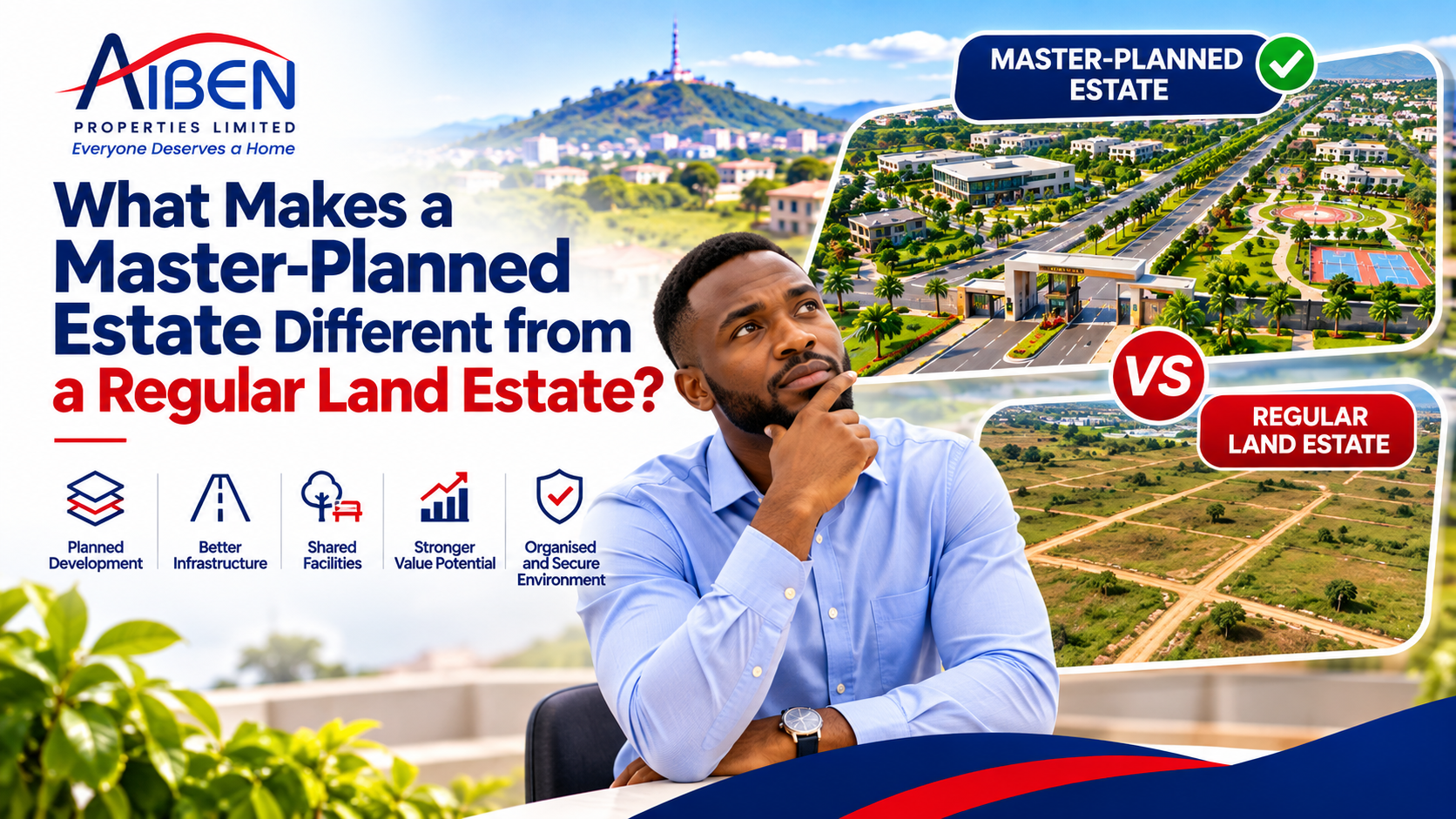
What Makes a Master-Planned Estate Different from a Regular Land Estate?
Introduction: Buying Land Is One Thing. Choosing the Right Development Is Another.
When searching for land in Abuja, many property buyers concentrate on three major things: location, plot size and price. While these factors are important, there is another consideration that deserves equal attention: the type of estate or development in which you are buying.
Two properties may have similar plot sizes and be located within the same general area, yet offer very different ownership experiences. One may be part of a carefully planned development with defined residential zones, commercial areas, road networks, drainage, utilities and recreational facilities. The other may simply be an area where individual plots have been sold to different buyers without a comprehensive development framework.
This is where the difference between a master-planned estate and a regular land estate becomes important.
A master-planned estate is designed around a broader vision. Instead of focusing exclusively on selling individual plots, the development considers how the entire environment should function, including where people will live, how they will move around, what facilities will support them and how different land uses will fit together.
For anyone considering property investment in Abuja, understanding this distinction can help you make a more informed decision.
At AIBEN Properties Limited, we believe that real estate development should go beyond the sale of land. It should involve creating well-considered development environments that respond to the needs of homeowners, investors, businesses and future communities.
In this guide, we explore what makes a master-planned estate different, why it matters and what you should examine before purchasing land in either type of development.
1. What Is a Master-Planned Estate?
A master-planned estate is a property development designed according to an overall plan that determines how the land will be organised, developed and used.
Rather than treating every plot as an independent property, the developer considers the wider environment before individual plots are marketed or developed. This involves planning the layout, road networks, land-use zones, infrastructure corridors, residential areas and supporting facilities.
Depending on the size and purpose of the development, a master-planned estate may include:
- Residential neighbourhoods and housing zones.
- Commercial and retail districts.
- Schools, healthcare and community facilities.
- Parks, gardens and recreational spaces.
- Internal road networks and pedestrian routes.
- Drainage and water infrastructure.
- Electricity and telecommunications infrastructure.
- Security arrangements and estate management facilities.
The objective is to create an organised environment where the different components are considered together rather than developed independently without coordination.
For example, a large master-planned estate may designate one section for residential homes, another for commercial activities and another for recreation. Roads, utilities and supporting infrastructure can then be planned around the intended functions of these areas.
This approach creates a clearer development framework and helps establish how the wider community is expected to function as different phases progress.
Importantly, a master plan is a planning framework, not proof that every proposed facility has already been constructed. Buyers should always distinguish between approved plans, completed infrastructure and future development proposals.
2. What Is a Regular Land Estate?
A regular land estate generally refers to a development where land is subdivided into individual plots and offered for sale, often primarily for buyers who intend to construct their own homes or hold the property as an investment.
Such estates can be properly planned, approved and professionally managed. Some may have good road networks, drainage, electricity and other essential facilities.
However, the scope of planning may be more limited than that of a large master-planned development. In some cases, the main emphasis is on plot subdivision, access roads and the sale of individual parcels rather than the integration of multiple land uses and community facilities.
For example, a regular residential land estate may provide plots for houses, with buyers independently developing their properties according to the applicable building guidelines.
There is nothing inherently wrong with this model. It can be suitable for people who simply want to acquire land and build a home according to their personal preferences.
The important thing is to understand what the developer has actually planned, approved and committed to delivering.
A regular land estate should not automatically be considered inferior, just as a development described as master-planned should not automatically be considered superior. The quality of the planning, documentation, infrastructure and execution matters more than the marketing label.
3. Master-Planned Estate vs Regular Land Estate: The Key Differences
The most important distinction is the scope of the development.
A regular land estate may focus mainly on making individual plots available for ownership, while a master-planned estate considers how different areas and facilities can work together within a larger development.
Here is a practical comparison:
| Feature | Master-Planned Estate | Regular Land Estate |
|---|---|---|
| Planning approach | Comprehensive development framework | May focus mainly on plot subdivision and basic estate layout |
| Land use | Can include residential, commercial, recreational and other designated zones | Often focused on one primary land use |
| Infrastructure | Planned as part of the wider development | May be provided in a more limited or phased arrangement |
| Road network | Designed around the overall layout and intended activities | Generally provides access to individual plots |
| Community facilities | May incorporate parks, schools, healthcare, retail and recreation | May have fewer shared facilities |
| Development phases | Can follow a coordinated long-term master plan | May be developed in smaller or less integrated phases |
| Estate management | May involve broader community and infrastructure management | Depends on the developer’s arrangements |
| Investment considerations | Offers a wider development context to evaluate | Usually evaluated around the plot, location and immediate surroundings |
The comparison is a general guide, not a guarantee of what any particular estate provides. Buyers should request the actual approved layout, development plan and infrastructure schedule before making a decision.
4. Infrastructure Is Planned as Part of the Bigger Picture
One of the most important advantages of a well-executed master-planned estate is the opportunity to coordinate infrastructure across the development.
Infrastructure is not simply about constructing roads or providing electricity. It involves understanding how different services will support the people and activities within the estate.
Consider a development with several residential neighbourhoods, commercial facilities and recreational areas. These uses have different infrastructure requirements. Residential areas need safe access, drainage, water and electricity. Commercial zones may require additional parking, access and utility capacity. Recreational areas may require landscaped spaces, pedestrian routes and supporting facilities.
When these requirements are considered together, infrastructure can be planned more systematically.
In a development where planning is limited to individual plots, infrastructure coordination may be less comprehensive, particularly when different owners begin constructing independently.
However, master planning alone does not guarantee that infrastructure will be delivered. Buyers should ask which facilities are already completed, which are funded and which are still proposed.
Before purchasing, investigate:
- The current condition of access roads.
- The approved internal road layout.
- Drainage and flood-management arrangements.
- Electricity supply and connection provisions.
- Water supply arrangements.
- Internet and telecommunications infrastructure.
- Security and estate management responsibilities.
For a wider understanding of how infrastructure influences property decisions, read our article on How Infrastructure Is Changing Property Values in Abuja in 2026.
5. Land Use Planning: Why It Matters Where You Buy
Imagine purchasing a plot with the intention of building a residential home, only to discover that the land is designated for commercial or another restricted use.
This is one reason land-use planning is an important part of property development.
A master-planned estate considers the intended purpose of different sections of the development. Depending on the approved plan, some areas may be reserved for residential buildings, while others may accommodate commercial activities, recreational facilities, public infrastructure or other permitted uses.
This helps establish an organised relationship between different activities.
For example, a commercial district may be positioned to serve surrounding residential communities, while recreational areas may be incorporated to provide shared spaces for residents and visitors.
In Abuja, physical planning and land-use monitoring are responsibilities of the relevant FCT planning authorities. The Federal Capital Territory Department of Urban and Regional Planning explains its responsibilities, including the preparation of land-use plans, detailed site development plans and monitoring of master plans.
This is particularly important for buyers because the development’s marketing description should not be confused with its officially permitted use.
Before purchasing, confirm the approved land use of the specific plot and establish whether your intended building or business activity is permitted.
6. Community Facilities Create a More Complete Living Environment
A home does not exist in isolation. The surrounding environment contributes significantly to the everyday experience of residents.
People need places to shop, exercise, relax, access essential services and interact with their communities. These considerations become particularly important in larger residential developments.
A master-planned estate may incorporate facilities such as:
Recreational spaces: Parks, gardens, walking routes, sports facilities and children’s play areas can support outdoor activities and community interaction.
Commercial facilities: Shopping areas, restaurants, convenience stores and other businesses can provide services within or near the development.
Community facilities: Depending on the approved plan, schools, healthcare facilities and other essential services may form part of the wider development.
Hospitality and lifestyle facilities: Larger developments may include hotels, event spaces, leisure destinations and other visitor-oriented facilities.
The availability of these facilities can influence how residents experience the estate and how the wider development serves different groups of people.
Nevertheless, buyers should verify which facilities currently exist and which are part of the proposed long-term vision. A facility appearing on a master plan is not necessarily available for immediate use.
7. Development Phases and Long-Term Planning
Large developments are rarely completed all at once. Depending on their size, financing, approvals and construction requirements, they may be delivered in phases over several years.
A master-planned estate provides a framework for coordinating those phases.
For example, a developer may begin with access roads and essential infrastructure, proceed with residential neighbourhoods and subsequently develop commercial or recreational components.
This allows the wider development to follow an organised direction while different sections progress at different times.
However, phased development also creates questions buyers should ask before committing to a property:
- What phase is currently under development?
- Which facilities have already been completed?
- What infrastructure is scheduled for the next phase?
- Are there documented development timelines?
- How will future phases connect with existing neighbourhoods?
- Who is responsible for maintaining completed infrastructure?
The answers help buyers understand the difference between what they are purchasing today and what may become available in the future.
For buyers interested in holding land before construction, our article Buying Land in Abuja and Building Years Later: A Landowner’s Planning Checklist explains the responsibilities involved in long-term property ownership.
8. Does a Master-Planned Estate Offer Better Investment Potential?
A master-planned estate can offer a broader investment proposition because the buyer is considering not only an individual plot but also the wider environment being developed around it.
A well-planned development may benefit from coordinated infrastructure, organised land use, accessible facilities and a more defined community structure.
These factors can influence how attractive the development is to prospective homeowners, businesses and future buyers.
Consider two properties with similar plot sizes.
One is located in an area with limited supporting infrastructure and no clear development framework. The other is within a development where roads, drainage, commercial areas, recreational spaces and residential zones have been carefully considered.
The second property may offer a different ownership proposition because the surrounding environment forms part of the wider development plan.
However, it is important not to assume that a master-planned estate will automatically appreciate faster or produce guaranteed investment returns.
Property performance depends on several factors, including:
- Location and accessibility.
- Land title and documentation.
- Actual infrastructure delivery.
- Demand for properties in the area.
- Quality of estate management.
- Development progress.
- Purchase price and holding costs.
- Broader economic and property market conditions.
The most important principle is to evaluate the actual development rather than relying on the master-planned label.
For more insight into property investment strategies, read How to Make Money From Real Estate in Abuja: 7 Smart Property Investment Strategies.
9. Why Documentation and Government Approvals Matter
A beautiful master plan is not enough. The underlying land and development must have the appropriate legal and regulatory foundation.
Before purchasing property in a master-planned estate, buyers should investigate the ownership of the land, relevant title documents, approved layout and applicable development permissions.
The FCT Department of Land Administration is responsible for land administration functions within the Federal Capital Territory, including the processing of allocations, issuance of Rights of Occupancy and Certificates of Occupancy, and registration and management of land titles.
The Department of Development Control also provides information about building-plan submissions and development approvals in Abuja.
Buyers should establish whether the estate’s layout has received the necessary approvals and whether the particular plot is covered by the relevant documentation.
You should also understand that an approved estate layout does not automatically mean that every buyer can begin construction immediately. Individual building projects may still require the appropriate approvals.
For a more detailed explanation of the documentation involved in land ownership, read our guide: What Is the Difference Between a Plot Number, an Allocation Letter and a Land Title?.
You can also read How to Verify a Real Estate Developer in Abuja Before You Buy Property for a practical guide to checking a developer and the property being offered.
10. What Should You Check Before Buying in a Master-Planned Estate?
If you are considering buying land in a master-planned estate, do not stop at the brochure or architectural render. Take time to understand the development and the obligations attached to the property.
Here is a practical checklist.
1. Request the master plan.
Ask to see the overall layout and understand how residential, commercial, recreational and other areas are arranged.
2. Verify the approved land use.
Confirm that the particular plot is designated for your intended purpose.
3. Examine the property documentation.
Review the relevant title documents, survey information, purchase agreement and applicable approvals.
4. Inspect the development physically.
Visit the site to assess accessibility, surrounding development, existing infrastructure and the actual condition of the property.
5. Understand the infrastructure schedule.
Ask which facilities are already available, which are being constructed and which are planned for future phases.
6. Review the estate management arrangements.
Understand how shared facilities, maintenance, security and other common responsibilities will be managed.
7. Calculate the full cost of ownership.
Consider the purchase price, documentation expenses, applicable infrastructure charges, maintenance contributions and future construction costs.
8. Understand the development timeline.
Ask about the current phase and any documented commitments relating to future development.
9. Obtain independent professional advice.
Where necessary, engage a property lawyer, registered surveyor or other qualified professional to review the transaction.
A property purchase should be based on evidence, not assumptions. The more clearly you understand the development, the better positioned you are to make an informed decision.
11. How AIBEN Properties Is Thinking Beyond Conventional Estate Development
At AIBEN Properties Limited, we believe that real estate development should be approached with a wider vision.
The future of property development is not simply about creating more plots for sale. It is also about understanding how residential communities, commercial activities, recreation, infrastructure and other facilities can come together to create more complete development environments.
This thinking is reflected in the wider HUTU PRESTIGE development concept.
The HUTU master plan presents a broader development vision incorporating residential communities, commercial hubs, recreational destinations, hospitality concepts and other supporting components.
Rather than focusing exclusively on individual residential plots, the wider development considers how different zones can serve different purposes within a larger environment.
You can explore the concept through our article HUTU PRESTIGE Abuja: 30 Special Features Across Its Mountain, Green City and Polo Modules.
The wider vision is also illustrated in the HUTU Abuja City Master Plan, which presents different development zones and their intended uses.
For prospective buyers and investors, this provides an opportunity to look beyond the individual plot and understand the wider development concept.
AIBEN Properties is committed to exploring real estate opportunities that respond to the changing needs of homeowners, businesses and investors in Abuja and beyond.
Our ambition is to contribute to the development of environments where people can live, work, invest and enjoy a better property ownership experience.
12. Which Is Better: A Master-Planned Estate or a Regular Land Estate?
There is no universal answer. The right choice depends on your objectives, budget, intended use and expectations.
A regular land estate may be suitable if you simply want to acquire a residential plot, build at your own pace and do not require an extensive range of shared facilities.
A master-planned estate may be more suitable if you are interested in a development with a broader planning framework, different land-use zones, coordinated infrastructure and the potential for supporting community facilities.
For families, the wider environment and availability of recreational or community facilities may be important.
For investors, the development framework, location, infrastructure, demand and long-term management arrangements may deserve greater attention.
For business owners, permitted land use, access, commercial facilities and operational suitability may be the deciding factors.
The best property is therefore not necessarily the one with the biggest master plan or the most impressive marketing materials. It is the one that is properly documented, suitable for your objectives and supported by a development framework that can be independently assessed.
Frequently Asked Questions
What is the meaning of a master-planned estate?
A master-planned estate is a property development designed around an overall plan that considers land use, roads, infrastructure, residential areas, commercial zones and supporting facilities. It provides a coordinated framework for how the wider development is intended to function.
What is the difference between a master-planned estate and a regular estate?
A master-planned estate generally considers the wider development environment and how different land uses and facilities work together. A regular land estate may focus more narrowly on dividing land into plots for individual ownership. However, regular estates can also be professionally planned and properly serviced.
Are master-planned estates more expensive?
Not necessarily. Prices depend on location, plot size, title documentation, infrastructure, facilities, development stage and market demand. Buyers should compare the full cost and benefits of individual developments rather than assume that one type is always more expensive.
Does buying land in a master-planned estate guarantee appreciation?
No. A master plan does not guarantee that property prices will increase. Appreciation depends on actual development progress, infrastructure, location, demand, documentation and broader economic conditions.
Can I build my own house in a master-planned estate?
In many master-planned estates, buyers can construct their own buildings, provided the proposed development complies with the approved land use, building guidelines, estate rules and relevant government requirements. Confirm the specific conditions before purchasing.
Are all facilities in a master-planned estate available immediately?
No. Large developments are often delivered in phases. Some facilities may already exist, while others may be under construction or planned for later phases. Always request an updated development and infrastructure schedule.
How can I verify a master-planned estate in Abuja?
Request the approved master plan, relevant land documentation and development approvals. Verify the property’s title through the appropriate FCT land administration channels, inspect the site and seek independent professional advice where necessary.
Conclusion: Look Beyond the Plot. Understand the Development.
The difference between a master-planned estate and a regular land estate goes beyond the number of facilities advertised or the appearance of a development brochure.
It comes down to how the land is organised, how infrastructure is considered, how different land uses are coordinated and how the wider environment is intended to function.
A regular land estate can be a suitable choice for someone who simply wants to acquire land and build a home. A master-planned estate can offer a broader development proposition for buyers who value coordinated planning, supporting facilities and a wider community environment.
However, the quality of the planning, the strength of the documentation and the actual delivery of infrastructure should always guide your decision.
At AIBEN Properties Limited, we believe that everyone deserves more than just a piece of land. Every property decision should be supported by clear information, proper planning and an understanding of the environment in which that property exists.
If you are exploring property opportunities in Abuja, take time to look beyond the plot size and purchase price. Understand the development, examine the master plan and choose a property that aligns with your long-term objectives.
AIBEN Properties — Everyone Deserves a Home.