

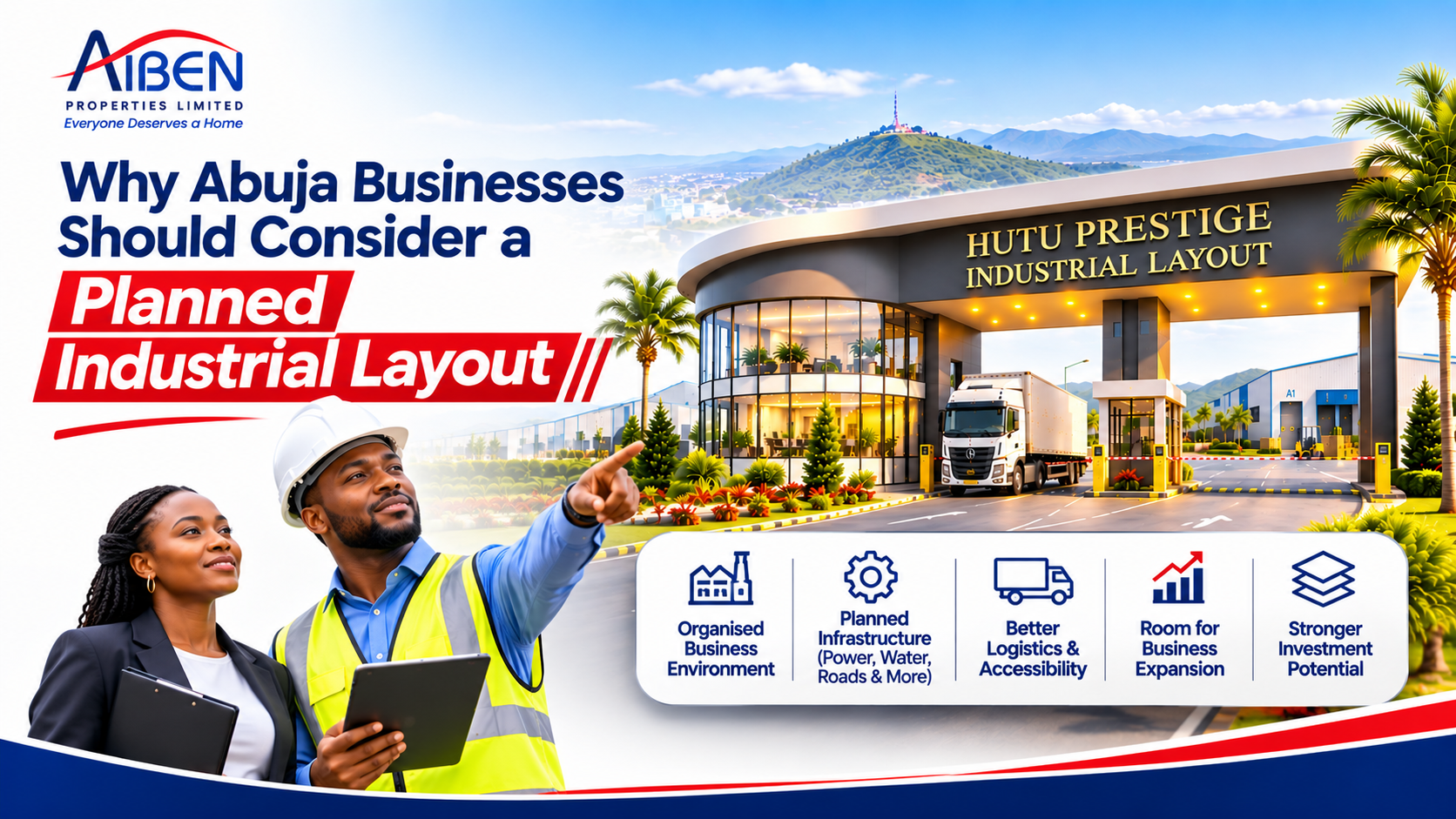
Why Abuja Businesses Should Consider a Planned Industrial Layout
The success of a business is influenced by more than the quality of its products, services or management. Where a business operates can also determine how efficiently it functions, how easily it reaches customers and how well it prepares for future expansion.
For manufacturers, distributors, logistics companies, importers and other industrial operators, choosing the right location is an important business decision. A poorly organised industrial environment can create operational difficulties, while a properly planned development can provide a more structured setting for business activities.
As Abuja continues to attract businesses, investments and commercial developments, the need for organised industrial locations deserves greater attention. Businesses looking to establish new facilities or expand existing operations should consider not just the price of land but also the wider development framework surrounding it.
This is where a planned industrial layout becomes important.
A planned industrial layout offers an organised approach to land allocation, infrastructure planning, access routes and the arrangement of industrial activities. Rather than approaching land development as a collection of individual plots, it considers how the entire development is intended to function.
For businesses considering industrial property in Abuja, understanding these advantages can help guide better property and investment decisions.
1. Better Organisation of Industrial and Business Activities
One of the major advantages of a planned industrial layout is the organisation of the development itself.
Industrial businesses have different operational requirements. Manufacturing companies may need production facilities, equipment areas and storage spaces, while logistics operators require access roads, loading areas and warehouses. Distributors may need facilities that support the movement and temporary storage of goods.
When industrial land is developed without a coordinated layout, businesses may encounter challenges relating to access, land use compatibility and the arrangement of neighbouring properties.
A planned industrial development provides a framework for organising plots and considering how different business activities fit into the wider environment.
This does not mean every business will have identical requirements. Rather, it creates an opportunity for industrial activities to operate within a more coordinated development structure, subject to the approved land-use conditions.
For companies planning to establish long-term operations in Abuja, this level of organisation is an important consideration.
2. More Considered Infrastructure Planning
Industrial operations depend on infrastructure. Electricity, water, roads, drainage, internet connectivity and security arrangements can all influence how efficiently a business functions.
A manufacturing facility, for example, may require substantial electricity capacity to operate machinery, while a distribution centre may depend heavily on road accessibility and suitable loading arrangements.
A planned industrial layout allows infrastructure requirements to be considered as part of the wider development process.
However, businesses must distinguish between infrastructure that has already been delivered, infrastructure currently under construction and facilities that remain proposed. A master plan or development proposal should not automatically be interpreted as evidence that every service is operational.
Before purchasing land, businesses should request the developer’s infrastructure information, delivery schedule and applicable connection arrangements.
The Federal Capital Territory’s planning and development control authorities provide important information on physical planning and development requirements. Businesses can consult the FCT Department of Urban and Regional Planning and FCT Department of Development Control when reviewing relevant planning considerations.
3. Improved Consideration for Logistics and Accessibility
The movement of goods is central to many industrial businesses.
Manufacturers receive raw materials, warehouses manage incoming and outgoing inventory, and distribution companies transport products to customers and commercial destinations. These activities require locations that can support regular vehicle movement.
A planned industrial layout provides an opportunity to consider road networks, plot positioning and access arrangements within the overall development design.
For businesses, this can make it easier to evaluate whether a particular location is suitable for their operational needs.
When assessing an industrial property, consider:
- Accessibility for heavy-duty vehicles and delivery trucks.
- Connections to major transport routes.
- Space for loading and unloading.
- Internal road arrangements.
- Distance to suppliers, customers and distribution destinations.
- Current road conditions and proposed improvements.
For businesses exploring industrial opportunities along the Airport Road corridor, location and connectivity are important factors to investigate.
The proposed positioning of HUTU PRESTIGE INDUSTRIAL LAYOUT along Airport Road makes it relevant to businesses considering industrial property within this part of Abuja. Prospective buyers should independently assess actual access conditions and obtain current information about the development.
4. More Suitable Land Planning for Different Business Requirements
Not every business needs the same amount of industrial land.
A small-scale production facility may require a different plot size from a large manufacturing company with multiple production buildings, storage facilities, parking and equipment areas.
Similarly, a logistics operator may prioritise warehouse space, vehicle circulation and loading areas, while an agro-processing company may need room for processing, storage and supporting operations.
A planned industrial layout makes it possible to consider different land requirements within a coordinated development framework.
Before selecting an industrial plot, businesses should evaluate:
- The proposed building footprint.
- Machinery and equipment requirements.
- Warehouse and storage capacity.
- Vehicle parking and circulation.
- Loading and unloading areas.
- Required setbacks and planning conditions.
- Space for future expansion.
Choosing an appropriate plot size can help businesses avoid unnecessary land costs while ensuring that their facilities have room to function effectively.
At HUTU PRESTIGE INDUSTRIAL LAYOUT, prospective buyers can enquire about available plot options and discuss their intended business requirements with AIBEN Properties.
5. Better Preparation for Business Expansion
Businesses rarely remain the same throughout their operating lives.
A company may begin with a relatively small production facility and later require additional storage, larger machinery, administrative offices or expanded distribution capacity.
If the original location cannot accommodate these changes, the business may face the additional expense and disruption of relocating.
A planned industrial development can provide a more considered environment for evaluating future business requirements, depending on available land, development phases and applicable planning conditions.
This makes long-term planning an important part of industrial property selection.
Businesses should not only ask whether a plot can accommodate their present operations. They should also consider whether the location and available land options can support their anticipated growth.
The objective is to make a property decision that aligns with the business’s long-term strategy rather than focusing exclusively on its immediate requirements.
6. A More Structured Environment for Industrial Investment
Industrial property can appeal to different categories of investors.
Some buyers intend to establish their own manufacturing or distribution facilities. Others may acquire land for future development, subject to market demand, planning permissions and the applicable terms of ownership.
A planned industrial layout can provide a clearer development framework within which buyers assess land use, plot arrangements, infrastructure plans and potential business applications.
For investors, this creates an opportunity to evaluate the property beyond the initial acquisition price.
Important considerations include the developer’s documentation, the approved land use, infrastructure commitments, development schedule, accessibility and the likely cost of making the property operational.
It is also important to remember that industrial land does not guarantee rental income or capital appreciation. Returns depend on several factors, including location, demand, development costs, legal documentation and the investor’s eventual use of the property.
For a broader understanding of property investment considerations, read our guide on How to Make Money From Real Estate in Abuja: 7 Smart Property Investment Strategies.
7. A More Coordinated Approach to the Industrial Development Process
Developing an industrial property involves more than acquiring land and constructing a building.
Businesses may need to consider site preparation, building approvals, environmental requirements, utility connections, access arrangements and other regulatory obligations.
A planned industrial layout provides an overall development framework that buyers can examine before committing to a particular plot.
This is valuable because it encourages businesses to evaluate the property in relation to the wider development rather than considering the individual plot in isolation.
However, the developer’s approved layout does not replace the permits and approvals required for a buyer’s specific building or industrial activity. Businesses must establish their own regulatory obligations before construction or operations begin.
The FCT Department of Development Control provides information about development control and building-plan requirements within the Federal Capital Territory.
8. Why Location Matters When Choosing an Industrial Layout in Abuja
Abuja’s position as Nigeria’s Federal Capital makes it an important location for government-related activities, commercial services, distribution and business operations.
For companies considering industrial property, the location must be evaluated in relation to their suppliers, customers, workforce, transportation requirements and operational costs.
Airport Road is one of the corridors businesses may consider when assessing industrial development opportunities in Abuja.
However, selecting a location should involve more than relying on a project’s advertised proximity to major destinations. Buyers should examine actual travel routes, traffic conditions, road accessibility and the suitability of the location for their particular operations.
A location that works well for a warehouse may not necessarily be ideal for a manufacturing business with specialised transportation or utility requirements.
The right industrial location is therefore one that supports the practical needs of the business.
HUTU PRESTIGE INDUSTRIAL LAYOUT: AIBEN Properties’ Industrial Development Vision
As businesses explore organised industrial property opportunities in Abuja, HUTU PRESTIGE INDUSTRIAL LAYOUT by AIBEN Properties presents an opportunity worth examining.
The development is positioned as a 53-hectare industrial layout along Airport Road, Abuja, with an industrial land-use focus and government permits identified in its project marketing documentation.
Its purpose is to provide industrial land opportunities for businesses and investors considering manufacturing, warehousing, logistics, agro-processing, distribution and other suitable industrial activities.
The development’s positioning is particularly relevant to businesses seeking to evaluate industrial land within a dedicated layout rather than acquiring an isolated plot without considering the wider development framework.
HUTU PRESTIGE INDUSTRIAL LAYOUT also forms part of the broader HUTU PRESTIGE development vision, which includes residential, commercial, recreational and hospitality-oriented components.
This wider development concept provides additional context for understanding the scale and ambition of the HUTU project.
Businesses interested in the opportunity should request the relevant title and approval documents, approved layout, available plot sizes, current pricing, payment conditions and infrastructure delivery information before making a purchase decision.
Explore more about HUTU PRESTIGE INDUSTRIAL CITY – A New Vision for Business, Industry and Investment in Abuja.
You can also examine the HUTU PRESTIGE master plan to understand the wider development concept.
What Should Businesses Check Before Choosing a Planned Industrial Layout?
Although planned industrial developments offer important considerations for businesses, buyers should still conduct proper due diligence before committing to a property.
Here are some important questions to ask:
1. Is the land officially designated for industrial use?
Confirm the approved land use and establish whether your intended business activity is permitted.
2. Are the ownership and approval documents available?
Request the relevant title documents, survey information, approved layout and government permits. Have them independently reviewed.
3. What infrastructure is currently available?
Establish which services have been delivered, which are under development and which are proposed for the future.
4. Can the location support your transportation needs?
Assess road accessibility, vehicle movement, loading arrangements and connections to your business destinations.
5. Does the plot size suit your operations?
Consider present building requirements, equipment, storage and future expansion.
6. What is the total cost of ownership and development?
Look beyond the purchase price to consider construction, utility connections, documentation, site preparation and other applicable expenses.
7. What are the developer’s obligations?
Review the purchase agreement, infrastructure commitments, development schedule and responsibilities of both parties.
For additional guidance, read How to Verify a Real Estate Developer in Abuja Before You Buy Property.
Final Thoughts: Plan Your Business Location for the Future
Choosing an industrial location is a decision that can influence how a business operates, expands and manages its long-term costs.
A planned industrial layout offers an opportunity to evaluate land within a broader framework of organisation, infrastructure planning, accessibility and industrial development.
For businesses considering Abuja, the important thing is to look beyond the immediate price of land and assess how the proposed location aligns with their operational and investment objectives.
HUTU PRESTIGE INDUSTRIAL LAYOUT by AIBEN Properties is one development worth exploring for businesses seeking industrial land opportunities along Airport Road, Abuja.
Whether you are planning a manufacturing facility, warehouse, distribution centre or another suitable industrial operation, the right starting point is to understand your requirements, examine the available documentation and evaluate the development carefully.
Your business needs more than space. It needs the right foundation for growth.
HUTU PRESTIGE INDUSTRIAL LAYOUT
A new ground for greatness.
AIBEN PROPERTIES LIMITED
Everyone Deserves a Home.
To request information about available industrial plots, pricing, payment arrangements or site inspections, visit AIBEN Properties or contact our team.